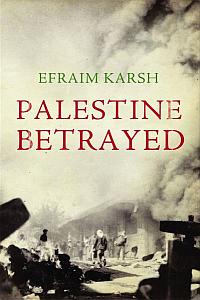
Palestine Betrayed
by Efraim Karsh
Yale, 336 pp., $32.50
Reviewed by Daniel Pipes
National Review
May 17, 2010
Nakba, the Arabic word for "catastrophe," has entered the English language in reference to the Arab-Israeli conflict. As defined by the anti-Israel website The Electronic Intifada, Nakba means "the expulsion and dispossession of hundreds of thousands [of] Palestinians from their homes and land in 1948."
 Those who wish Israel to disappear actively promote the Nakba narrative. For example, Nakba Day serves as a mournful Palestinian counterpart to Israel's Independence Day festivities, annually publicizing Israel's alleged sins. So established has this day become that Ban Ki-moon, secretary general of the United Nations - the very institution that created the State of Israel - has sent his support to "the Palestinian people on Nakba Day." Even Neve Shalom, a Jewish-Palestinian community in Israel claiming to be "engaged in educational work for peace, equality, and understanding between the two peoples," dutifully commemorates Nakba Day.
The Nakba ideology presents Palestinians as victims without choices and therefore without responsibility for the ills that befell them. It blames Israel alone for the Palestinian-refugee problem. This view has an intuitive appeal, for Muslim and Christian Palestinians had long formed a majority on the land that became Israel, whereas most Jews were relative newcomers.
Intuitive sense, however, does not equal historical accuracy. In his new tour de force, Palestine Betrayed, Efraim Karsh of the University of London offers the latter. With his customary in-depth archival research - in this case, relying on masses of recently declassified documents from the period of British rule and of the first Arab-Israeli war, 1917-49 - clear presentation, and meticulous historical sensibility, Karsh argues the opposite case: that Palestinians decided their own destiny and bear near-total responsibility for becoming refugees.
In Karsh's words: "Far from being the hapless victims of a predatory Zionist assault, it was Palestinian Arab leaders who, from the early 1920s onward, and very much against the wishes of their own constituents, launched a relentless campaign to obliterate the Jewish national revival which culminated in the violent attempt to abort the U.N. partition resolution." More broadly, he observes, "there was nothing inevitable about the Palestinian-Jewish confrontation, let alone the Arab-Israeli conflict."
Yet more counterintuitively, Karsh shows that his understanding was the conventional, indeed the undisputed interpretation in the late 1940s. Only with the passage of time did "Palestinians and their Western supporters gradually rewr[i]te their national narrative," thereby making Israel into the unique culprit, the one excoriated in the United Nations, university classrooms, and editorials.
Karsh successfully makes his case by establishing two main points: that (1) the Jewish-Zionist-Israeli side perpetually sought to find a compromise while the Palestinian-Arab-Muslim side rejected nearly all deals; and (2) Arab intransigence and violence caused the self-inflicted "catastrophe."
The first point is more familiar, especially since the Oslo Accords of 1993, for it remains today's pattern. Karsh demonstrates a consistency of Jewish goodwill and Arab rejectionism going back to the Balfour Declaration and persisting throughout the period of British rule. (To remind, the Balfour Declaration of 1917 expressed London's intention to establish in Palestine a "national home for the Jewish people," and the British conquest of Palestine just 37 days later gave it control of Palestine until 1948.)
In the first years after 1917, Arab reaction was muted, as leaders and masses alike recognized the benefits of the dynamic Zionist enterprise that helped revive a backward, poor, and sparsely populated Palestine. Then emerged, with British facilitation, the noxious figure who would dominate Palestinian politics over the next three decades, Amin al-Husseini. From about 1921 on, Karsh documents, Zionists and Palestinians had many choices to make; while the former invariably opted for compromise, the latter relentlessly decided on extermination.
In various capacities - mufti, head of Islamic and political organizations, Hitler ally, hero of the Arab masses - Husseini drove his constituents to what Karsh calls "a relentless collision course with the Zionist movement." Hating Jews so maniacally that he went on to join the Nazi genocide machine, Husseini refused to accept their presence in any numbers in Palestine, much less any form of Zionist sovereignty.
From the early 1920s, then, one witnessed a pattern still in place and familiar today: Zionist accommodation, "painful concessions," and constructive efforts to bridge differences, met by Palestinian anti-Semitism, rejectionism, and violence.
Complementing this binary dramatis personae, and complicating its stark contrast, stood the generally more accommodating Palestinian masses, the disgracefully anti-Semitic British mandatory authority, a Jordanian king eager to rule the Jews as subjects, feckless Arab state leaders, and an erratic American government.
Despite the radicalization of Palestinian opinion by the mufti and despite the Nazi rise to power, Zionists kept seeking an accommodation. It took some years, but the mufti's zero-sum policy and eliminationism eventually convinced reluctant Labor leaders, including David Ben-Gurion, that good works would not facilitate their dream of acceptance. Still, despite repeated failures, they continued the search for a moderate Arab partner with whom to strike a deal.
In contrast, Ze'ev Jabotinsky, the forerunner of today's Likud party, already in 1923 understood that "there is not even the slightest hope of ever obtaining the agreement of the Arabs of the Land of Israel to 'Palestine' becoming a country with a Jewish majority." Yet even he rejected the idea of expelling Arabs and insisted on their full enfranchisement in a future Jewish state.
This dialectic culminated in November 1947, when the United Nations passed a partition plan that nowadays would be termed a two-state solution. In other words, it handed the Palestinians a state on a silver platter. Zionists rejoiced but Palestinian leaders, foremost the malign Husseini, sourly rejected any solution that endorsed Jewish autonomy. They insisted on everything and so got nothing. Had they accepted the U.N. plan, Palestine would be celebrating its 62nd anniversary this May. And there would have been no Nakba.

"Had they accepted the U.N. plan, Palestine would be celebrating its 62nd anniversary this May. And there would have been no Nakba"
The most original part of Palestine Betrayed is the half that contains a detailed review of the flight of Muslims and Christians from Palestine in the years 1947-49. Here Karsh's archival research comes into its own, allowing him to present a uniquely rich picture of the specific circumstances of Arab flight. He goes one by one through the various Arab population centers - Qastel, Deir Yassin, Tiberias, Haifa, Jaffa, Jerusalem, Safad - and then takes a close look at the villages.
Israel's war of independence divides into two parts. Ferocious fighting began within hours of the United Nations vote to partition Palestine on Nov. 29, 1947, and lasted till the eve of the British evacuation on May 14, 1948. The international conflict began on May 15 (the day after Israel came into being), when five Arab state armies invaded, with hostilities lasting until January 1949. The first phase consisted largely of guerrilla warfare, the second primarily of conventional warfare. Over half (between 300,000 and 340,000) of the 600,000 Arab refugees fled before the British evacuation, and most of them in the final month.
Palestinians fled in a wide range of circumstances and for varied reasons. Arab commanders ordered noncombatants out of the way of military maneuvers; or they threatened laggards with treatment as traitors if they stayed; or they demanded that villages be evacuated to improve their standing on the battlefield; or they promised a safe return in a matter of days. Some communities preferred to flee rather than to sign a truce with the Zionists; in the words of Jaffa's mayor, "I do not mind destruction of Jaffa if we secure destruction of Tel Aviv." The mufti's agents attacked Jews to provoke hostilities. Families with the means to do so fled danger. When agricultural tenants heard that their landlords would be punished, they worried about being expelled and preempted by abandoning the land. Bitter internecine enmities hobbled planning. Shortages of food and other necessities spread. Services like water-pumping stations were abandoned. Fears spread of Arab gunmen, as did rumors of Zionist atrocities.
In only one case (Lydda) did Israeli troops push Arabs out. The singularity of this event bears emphasis. Karsh explains about the entire first phase of fighting: "None of the 170,000-180,000 Arabs fleeing urban centers, and only a handful of the 130,000-160,000 villagers who left their homes, had been forced out by Jews."
The Palestinian leadership disapproved of a population return, seeing this as implicitly recognizing the nascent State of Israel. The Israelis were at first ready to take back the evacuees but then hardened their position as the war progressed. Prime Minister Ben-Gurion explained their thinking, on June 16, 1948: "This will be a war of life and death and [the evacuees] must not be able to return to the abandoned places. … We did not start the war. They made the war. Jaffa waged war on us, Haifa waged war on us, Beisan waged war on us. And I do not want them again to make war."
In sum, Karsh explains, "it was the actions of the Arab leaders that condemned hundreds of thousands of Palestinians to exile."
In this book, Karsh establishes two momentous facts: that Arabs aborted the Palestinian state and that they caused the Nakba. In the process, he confirms his status as the preeminent historian of the modern Middle East writing today, and extends the arguments of three of his earlier books. His magnum opus, Empires of the Sand: The Struggle for Mastery in the Middle East, 1789-1923 (with Inari Karsh, 1999), argued that Middle Easterners were not, as usually thought, "hapless victims of predatory imperial powers but active participants in the restructuring of their region," a shift with vast political implications. Palestine Betrayed applies that book's thesis to the Arab-Israeli conflict, depriving Palestinians of excuses and victimhood, showing that they actively, if mistakenly, chose their destiny.
In Fabricating Israeli History: The "New Historians" (1997), Karsh exposed the shoddy work, even the fraudulence, of the school of Israeli historians who blame the 1948-49 Palestinian refugee problem on the Jewish state. Palestine Betrayed offers the flip side; if the earlier book refuted mistakes, this one establishes truths. Finally, in Islamic Imperialism: A History (2006), he showed the expansionist core of the Islamic faith in action over the centuries; here he explores that drive in small-bore detail among the Palestinians, connecting the supremacist Islamic mentality with an unwillingness to make practical concessions to Jewish sovereignty.
Palestine Betrayed reframes today's Arab-Israeli debate by putting it into its proper historical context. Proving that for 90 years the Palestinian political elite has opted to reject "the Jewish national revival and [insisted on] the need for its violent destruction," Karsh correctly concludes that the conflict will end only when the Palestinians give up on their "genocidal hopes."
Mr. Pipes is a columnist for National Review Online, director of the Middle East Forum, and Taube distinguished visiting fellow at the Hoover Institution.
Not Stealing Palestine but Purchasing Israel
by Daniel Pipes
National Review Online
June 21, 2011
 Zionists stole Palestinian land: that's the mantra both the Palestinian Authority and Hamas teach their children and propagate in their media. This claim has vast importance, as Palestinian Media Watch explains: "Presenting the creation of the [Israeli] state as an act of theft and its continued existence as a historical injustice serves as the basis for the PA's non-recognition of Israel's right to exist." The accusation of theft also undermines Israel's position internationally.
But is this accusation true?
No, it is not. Ironically, the building of Israel represents about the most peaceable in-migration and state creation in history. To understand why requires seeing Zionism in context. Simply put, conquest is the historic norm; governments everywhere were established through invasion, nearly all states came into being at someone else's expense. No one is permanently in charge, everyone's roots trace back to somewhere else.
represents about the most
peaceable in-migration and
state creation in history.
Germanic tribes, Central Asian hordes, Russian tsars, and Spanish and Portuguese conquistadors remade the map. Modern Greeks have only a tenuous connection to the Greeks of antiquity. Who can count the number of times Belgium was overrun? The United States came into existence by defeating Native Americans. Kings marauded in Africa, Aryans invaded India. In Japan, Yamato-speakers eliminated all but tiny groups such as the Ainu.
The Middle East, due to its centrality and geography, has experienced more than its share of invasions, including the Greek, Roman, Arabian, Crusader, Seljuk, Timurid, Mongolian, and modern European. Within the region, dynastic froth caused the same territory - Egypt for example - to be conquered and re-conquered.
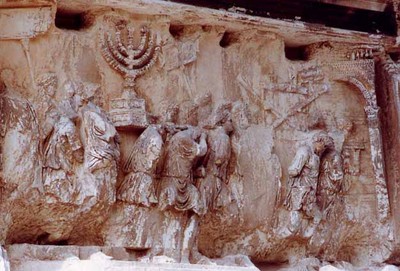 Many wars over Jerusalem: Emperor Titus celebrated his victory over the Jews in 70 A.D. with an arch showing Roman soldiers carrying off a menorah from the Temple.
The land that now makes up Israel was no exception. In Jerusalem Besieged: From Ancient Canaan to Modern Israel, Eric H. Cline writes of Jerusalem: "No other city has been more bitterly fought over throughout its history." He backs up that claim, counting "at least 118 separate conflicts in and for Jerusalem during the past four millennia." He calculates Jerusalem to have been destroyed completely at least twice, besieged 23 times, captured 44 times, and attacked 52 times. The PA fantasizes that today's Palestinians are descended from a tribe of ancient Canaan, the Jebusites; in fact, but they are overwhelmingly the off-spring of invaders and immigrants seeking economic opportunities.
Against this tableau of unceasing conquest, violence, and overthrow, Zionist efforts to build a presence in the Holy Land until 1948 stand out as astonishingly mild, as mercantile rather than military. Two great empires, the Ottomans and the British, ruled Eretz Yisrael; in contrast, Zionists lacked military power. They could not possibly achieve statehood through conquest.
dunam, farm by farm,
house by house, lay at
the heart of the Zionist enterprise
until 1948.
Instead, they purchased land. Acquiring property dunam by dunam, farm by farm, house by house, lay at the heart of the Zionist enterprise until 1948. The Jewish National Fund, founded in 1901 to buy land in Palestine "to assist in the foundation of a new community of free Jews engaged in active and peaceable industry," was the key institution - and not the Haganah, the clandestine defense organization founded in 1920.
Zionists also focused on the rehabilitation of what was barren and considered unusable. They not only made the desert bloom but drained swamps, cleared water channels, reclaimed wasteland, forested bare hills, cleared rocks, and removed salt from the soil. Jewish reclamation and sanitation work precipitously reduced the number of disease-related deaths.

out attempt by Arab states
to crush and expel the
Zionists, did the latter take
up the sword in self defense
and go on to win land
through military conquest.
Only when the British mandatory power gave up on Palestine in 1948, followed immediately by an all-out attempt by Arab states to crush and expel the Zionists, did the latter take up the sword in self defense and go on to win land through military conquest. Even then, as the historian Efraim Karsh demonstrates in Palestine Betrayed, most Arabs fled their lands; exceedingly few were forced off.
This history contradicts the Palestinian account that "Zionist gangs stole Palestine and expelled its people" which led to a catastrophe "unprecedented in history" (according to a PA 12th-grade textbook) or that Zionists "plundered the Palestinian land and national interests, and established their state upon the ruins of the Palestinian Arab people" (writes a columnist in the PA's daily). International organizations, newspaper editorials, and faculty petitions reiterate this falsehood worldwide.
Israelis should hold their heads high and point out that the building of their country was based on the least violent and most civilized movement of any people in history. Gangs did not steal Palestine; merchants purchased Israel.
Mr. Pipes is president of the Middle East Forum and Taube distinguished visiting fellow at the Hoover Institution of Stanford University.
June 21, 2011 addendum: For additional points that did not fit this column, see the weblog entry, "Extras about Zionists Purchasing Israel, Not Stealing Palestine."
June 22, 2011 update: Odd to be attacked from the right for pointing out that Zionists bought the land rather than steal it, but that's the case today on the Commentary magazine website, where I read that "It doesn't matter much how the land was acquired (though we did so legally) or what kind of land it was that we bought. It was - and is - ours by the natural right of the Jewish people to political independence in their native homeland."
That's all very nice but - breaking news, here - not exactly everyone accepts that the land is "ours by … natural right." For those skeptics it helps to establish that the land was legally acquired.
This critique at Commentary reminds me about the disdain for Palestinian recognition of Israel as the Jewish state (on which, see my weblog entry, "Israel Does Not Need Palestinian Recognition?"), where Zionists also manifest too much pride to heed realities.
June 23, 2011 update: A number of readers protested my reference above to "Aryans invaded India," saying that this is a discredited theory. In particular, Rajiv Malhotra sent me his article, "European Misappropriation of Sanskrit led to the Aryan Race Theory."
June 19, 2022 update: I reiterate this point in a letter to the editor of the Wall Street Journal.
The above text may be cited; it may also be reposted or forwarded so long as it is presented as an integral whole with complete information provided about its author, date, place of publication, and original URL.
Extras about Zionists Purchasing Israel, Not Stealing Palestine
by Daniel Pipes
Jun 21, 2011
updated Jun 30, 2022
https://www.danielpipes.org/blog/2011/06/zionists-purchasing-israel
Some additional points that did not fit my article today, "Not Stealing Palestine but Purchasing Israel":
- The ultimate justification for the Jewish presence is, of course, the ancient tie and the love of Zion, not modern land purchases; but these purchases reinforce the legitimacy of the in-migration.
- Israel's existence refutes Pascal Bruckner's generalization that "There is no state that is not founded on crime and coercion."
- The Partition Plan passed by the U.N. General Assembly in November 1947 allocated 14,900 sq. km to the Jewish state. When Israel's war of independence ended in March 1949, it controlled an area 20,500 sq. km., an increase of 37 percent.
- "Palestine" today represents the country that would rise out of Israel's elimination; but in the decades before the creation of Israel in 1948, the term represented Zionist aspirations.
- The anti-Zionist argument emphasizes that, at the time of the British withdrawal in 1948, Jews owned only 6 to 10 percent of the territory's land area. True, but when one discounts uncultivated and public land, the percentage becomes very much higher.
- For specifics on who owned what, see Moshe Aumann, "Land Ownership in Palestine, 1880-1948," in Isi Leibler. The Case for Israel (Melbourne: Executive Council of Australian Jewry, 1972), Appendix 2, and this passage in particular:
"In May 1948 the State of Israel was established in only part of the area allotted by the original League of Nations Mandate. 8.6 percent of the land was owned by Jews and 3.3 per cent by Israeli Arabs, while 16.9 per cent had been abandoned by Arab owners who imprudently heeded the call from neighbouring countries to "get out of the way" while the invading Arab armies made short shrift of Israel. The rest of the land-over 70 per cent-had been vested in the Mandatory Power, and accordingly reverted to the State of Israel as its legal heir."
- For more on land ownership, note this quote from Abraham Granott, The Land System in Palestine: History and Structure (London: Eyre and Spottiswoode, 1952), p. 278:
"The total area of land in Jewish possession at the end of June 1947 amounted to 1,850,000 dunams, of this 181,100 dunams had been obtained through concessions from the Palestinian Government, and about 120,000 dunams had been acquired from Churches, from foreign companies, from the Government otherwise than by concessions, and so forth. It was estimated that 1,000,000 dunams and more, or 57 per cent, had been acquired from large Arab landowners, and if to this we add the lands acquired from the Government, Churches, and foreign companies, the percentage will amount to seventy-three. From the fellaheen there had been purchased about 500,000 dunams, or 27 per cent, of the total acquired. The result of Jewish land acquisitions, at least to a considerable part, was that properties which had been in the hands of large and medium owners were converted into holding of small peasants."
- For the history of Jewish land purchases, see Kenneth W. Stein, The Land Question in Palestine, 1917-1939 (Chapel Hill: University of North Carolina Press, 1984).
- The Dutch purchased Manhattan for 60 guilders in 1626.
- Colonists and the United States government engaged in conquest against Indians; then, after the polity came into existence, Washington purchased substantial territories, including the Louisiana Purchase of 1803, the Florida (Adams-Onis Treaty) purchase of 1819, the Oregon Treaty of 1846, the Treaty of Guadalupe Hidalgo of 1848, the Gadsden Purchase of 1853, the Alaska Purchase of 1867, the Philippines purchase of 1898, and Danish West Indies purchase of 1917 - but all these came well after the founding of the state on July 4, 1776. (In addition, the U.S. government offered Denmark $100 million for Greenland in 1946, but was turned down.)
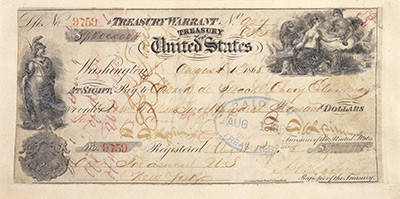
- Wikipedia has an interesting entry, "List of territory purchased by a sovereign nation from another sovereign nation," that puts the U.S. purchases into a larger context. Only two future countries were purchased, Singapore by the United Kingdom in 1824 and the above-mentioned Philippines purchase by the United States in 1898; obviously, neither were purchased by the inhabitants of those future countries.
- The 1947 United Nations partition borders were drawn precisely to include within the Jewish area those lands that had been purchased; had the Palestinians and Arab states not responded to partition by trying to snuff out the "Zionist entity," Israel today would likely be a quite tiny state delineated by the land purchased during the Mandatory era.
- Along with Hitler, the mufti was the chief unintended creator of the Zionist state. Had it not been for Husseini's ruthless, extremist, and vicious opposition to any Jewish presence in the Holy Land, modern Israel may not even exist today. Some Arabs realized this irony, such as the Arab League's American representative, Cecil Hourani, who noted in 1947 that "If a Jewish State is established in Palestine, [Zionists] will have to thank the Mufti."
- No less ironically, the one Arab leader who did accept the Jewish presence in Palestine and even saw it benefiting the Arabs, King Abdullah of Transjordan, nearly choked the Zionist enterprise to death at birth. As Efraim Karsh observes, "Had Abdullah discarded his Palestine (and Greater Syria) ambitions and played a less prominent role in the Palestine conflict, the Arab states might well have contented themselves with political posturing and military support for the Palestinians."
- By coincidence, the Wall Street Journal published an article yesterday, "What If Jews Had Followed the Palestinian Path?" by Warren Kozak that makes a parallel point to my own: "It is doubtful that there has ever been a more miserable human refuse than Jewish survivors after World War II... Yet within a very brief time, this epic calamity disappeared, so much so that few people today even remember the period. How did this happen in an era when Palestinian refugees have continued to be stateless for generations?"
(June 21, 2011)
July 31, 2016 update: In the article to which this is an addition, I stated that Palestinians "are overwhelmingly the off-spring of invaders and immigrants seeking economic opportunities." My blog today looks at the authoritative Encyclopædia Britannica, 11th edition, dating from 1910-11, to confirm this point and provide details on the many, many peoples who lived in the area known as Palestine.
July 18, 2020 update: Israelis continue to be accused of "stealing Palestinian land." Moshe Dann dispatches this calumny in an article today, "What is not 'private Palestinian land?'" He establishes that because most land on the West Bank "has not been registered, proving ownership is often difficult." It's a complex picture that again vindicates Israeli practices.
June 30, 2022 update: Mitchell Bard flips the "stolen" narrative on its head, suggesting that the BDS movement be directed instead at Jordan:
Isn't the minority tribal autocracy in Jordan akin to apartheid? Shouldn't human rights advocates focus their ire on the Hashemites, the true interlopers in Palestine, instead of the Jews who have lived in the land for millennia? Shouldn't the international community insist that Jordan be recognized as the Palestinian state and that Palestinians living in Gaza and the West Bank be given Jordanian citizenship?