1967: The 6 Day War: Nasser's Nakha, a Self-Inflicted Disaster
The Six-Day War (1967) according to Grokipedia: occurred from June 5 to June 10, 1967, pitting Israel against Egypt, Jordan, and Syria, with limited involvement from Iraq and other Arab states providing expeditionary forces. Israel achieved a swift and overwhelming victory, capturing the Sinai Peninsula and Gaza Strip from Egypt, the West Bank including East Jerusalem from Jordan, and the Golan Heights from Syria, thereby quadrupling its territorial control. The conflict stemmed from heightened regional tensions, including Syrian-Israeli border clashes and Palestinian fedayeen incursions, but the immediate triggers were Egypt's mobilization of approximately 100,000 troops in the Sinai Peninsula in May 1967, the expulsion of United Nations Emergency Force (UNEF) peacekeepers from the area, and the imposition of a naval blockade on the Straits of Tiran on May 22, which denied Israel access to the Red Sea and was regarded by Israel as a casus belli under international law.[23] [24]
The reality is that the 6-Day War was due to one man and one man only, Gamal Abdel Nasser, the leader of the pan-Nasserism movement, the Pharoah of Egypt and the would-be Dictator of his very own modern Arab Empire. While he gloried in titles like freedom-loving revolutionary, anti-imperialist, anti-Colonialist he was actually just another dictator-disaster who came to power through conspiracy and treachery and removed the King of Egypt and then his senior partner one at a time, or thousands at a time, then all the possible opponents he could think of on his way to the top.
On 26 September 1962, a pro-Nasserist coup d' état in Sanaa disposed of the Yemeni monarchy. Thus began Nasser's imperial settler-colonialist project in Yemen, with 70,000 Egyptian soldiers, administrators, doctors, technicians, and teachers attempting to build an illegal state in the occupied-territories of Yemen. However, the resistance of the Yemeni masses turned Nasser's imperial adventure into his Vietnam. Only hypcrisy can explain the lack of any Post-Colonial Studies critiques of this imperialist and colonial attempt to conquer Yemen. Financing this massive campaign severely drained Egypt's economy, widespread starvation was only prevented by a rationing system and food imports. Meat, oil, and bread became scarce. Egypt relied heavily on U.S. wheat through the Food for Peace (PL 480) program.
Nasser, the Arab Socialist Saint, was also president of the Non-Aligned Movement (NAM). He pranced and preached for anti-imperialist struggle and self-determination everywhere, condemning all old and new colonialism, all military terror and all the capitalist crimes against the daily struggle of the masses. The man could talk. Like Hitler to the Germans was Nasser to the Arabs. He was leading them to disaster:
"Our path to Palestine will not be covered with a red carpet or with yellow sand. Our path to Palestine will be covered with blood… In order that we may liberate Palestine, the Arab nation must unite, the Arab armies must unite, and a unified plan of action must be established. - Nasser election speech, 1965.
Obviously he was not referring to his own blood, he meant the 300,000 soldiers he sent to war knowing the Israeli Air Force would decimate them.
- On May 13, 1967, Soviet officials informed the Syrian and Egyptian Governments that Israel had massed troops on Syria's border. General Mohamed Fawzi, the Army Chief of Staff, went there and saw it was not true. Yet, Nasser carried on, …
- On May 15, Israel's Independence Day, Egyptian troops began moving into the Sinai and massing near the Israeli border.
- On May 16, Nasser ordered the UN Emergency Force, stationed in the Sinai since 1956, to withdraw.
- By May 18, Syrian troops were prepared for battle along the Golan Heights.
- May 18, 1967, the Voice of the Arabs announced:
"As of today, there no longer exists an international emergency force to protect Israel. We shall exercise patience no more. We shall not complain anymore to the UN about Israel. The sole method we shall apply against Israel is total war, which will result in the extermination of Zionist existence."13
- On May 20, Syrian defense minister Hafez Assad:
"Our forces are now entirely ready not only to repulse the aggression but [also] to initiate the act of liberation itself and to explode the Zionist presence in the Arab homeland. The Syrian army, with its finger on the trigger, is united … I, as a military man, believe that the time has come to enter into a battle of annihilation."14
- On May 22, 1967, Egypt blockaded the Gulf of Aqaba and continued to mass their forces in the Sinai.
- On May 23, 1967, Israeli Prime Minister Levi Eshkol addressed the Knesset declaring that Egyptian President Gamal Abdel Nasser's blockade of the Straits of Tiran to Israeli shipping and strategic cargoes was an "act of aggression against Israel" and a gross violation of international law, setting the stage for the Six-Day War.
- On 28 May 28, 1967, President Nasser announced at a press conference that "we intend to open a general assault on Israel. This will be total war. Our basic aim is the destruction of Israel."
Nearly every high-ranking Israeli general believed they could defeat the surrounding Arab armies within days though their confidence relied on launching a surprise, preemptive strike to neutralize enemy air forces. Israel's political leadership - especially Prime Minister Levi Eshkol - was far more anxious. The Israeli economy could not last too long under general mobilisation and Sharon believed thay waited too long before striking.
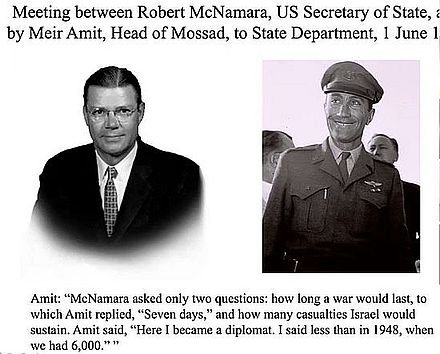 After a meeting between Robert McNamara, US Secretary of Defense, and Meir Amit, Head of Mossad, to US State Department, 1st June 1967 Amit recorded: "McNamara asked only 2 questions: how long a war would last, to which Amit replied, "Seven days," and how many casualties would Israel sustain. Here I became a diplomat. I said less than in 1948, when we had 6,000."
 Moshe Dayan was interviewed by British TV before the war began: "I think that both, ah, that Nasser knows that even now Israel is much, much stronger than his forces or all the Arab countries together forces. I have no doubt about it. And I think that Nasser knows that too. And that is to say that if he starts war, he's going to lose it. And secondly, which I think is very important, that Nasser is still in the position not to make war. That is to say, to stand, to stand and repulse the pressure coming from other Arab countries and probably also from inside Egypt. He's strong enough to to resist that."
- On June 5, 1967, at 07:45 Israeli time, a massive surprise airstrike targeted Egyptian air bases and destroyed the majority of the Egyptian Air Force on the ground. Later that day, Nasser phoned King Hussein of Jordan and told him that the Israeli Air Force had been entirely wiped out and the Egyptian Army was launching a massive attack on Israel. He also personally called Syrian President Noureddine al-Atassi and Field Marshal Hafez al-Assad and told them the same.
The overall story is simple. Israeli Air Force destroys the Egyptian Air Force on the ground and the Israelis have a dazzling week long victory. Israeli casualties totaled around 776 killed and 2,563 wounded, terrible for Israel but far less than the 20,000 or so Arab dead and the total defeat and destruction of their armies.
Why did Nasser carry on? He had already come up with the story of United States' collusion with the Israelis in destroying his air force. He couid have used that as an excuse not to attack. He just cared more for himself than for his followers. The Unholy Triumvirate of Palestine were Hajj Amin al-Husayni, Gamal Abdel Nasser and Yasser Arafat. Nasser was possibly the least heinous personally but did far more harm to his followers as he had more power over more people, the Palestinians just suffered as a side effect.
This a translation of the beginning of his resignation speech aired on Egyptian radio:
Brothers, at times of triumph and tribulation, in the sweet hours and bitter hours, we have become accustomed to sit together to discuss things, to speak frankly of facts believing that only in this way can we always find the right path however difficult circumstances may be. We cannot hide from ourselves the fact that we have met with a grave setback in the last few days, but I am confident that we all can and, in a short time, will overcome our difficult situation, although this calls for much patience and wisdom as well as moral courage on our part… Accurate calculations were made of the enemy's strength and showed us that our armed forces, at the level of equipment and training which they had reached, were capable of repelling the enemy and deterring him. We realized that the possibility of an armed clash existed and accepted the risk … In the morning of last Monday, 5th June, the enemy struck. If we say now it was a stronger blow than we had expected, we must say at the same time, and with complete certainty that it was bigger than the potential at this disposal. It became very clear from the first moment that there were other powers behind the enemy-they came to settle their accounts with the Arab national movement. Indeed, there were surprises worth of note
It begins with an outrageous lie. Nasser hasn't discussed anything with the Egyptian pubic, nor has he ever spoken frankly to them. Then he reveals the Big Lie, that it was the abject and wicked concealed imperialist collusion with the enemy i.e. American and British aircraft carrier planes that did the damage. The Egyptians to a man refuse to allow him to resign. It is reminiscent of his speech after the assassination attempt back in 1954 which raised him to godhood.
Surrounding countries that literally treated Israel as a mortal enemy and whose populations and religious leaders regularly called for its obliteration were massing for an invasion on multiple fronts. Who would have acted differently from Israel in seizing the opportunity to deal with them. Who would have won that astounding victory and then returned the captured territory?. Who wouldn't take control of the population's holy places. Knowing what Israel faced at the time, its actions were entirely rational and eminently defensible.
Following the failure of Nasser's war on Israel, and even during it, the Arabs began circulating a series of myths explaining away the defeat. Sadiq Jalal Al-Azm, a Professor Emeritus of Modern European Philosophy at the University of Damascus in Syria, wrote a book analogous to "The Meaning of the Disaster" by Constantine Zurayk and "The Lesson of Palestine" by Musa Alami, titled Self-Criticism After the Defeat. It had very little effect on the general Arab public who prefer to wallow in mythical
Notes
13 Isi Leibler, The Case for Israel, (Australia: The Globe Press, 1972), pp. 60-61.
14 Ibid.
A small collection of cartoons from Arab pulications of the day.